
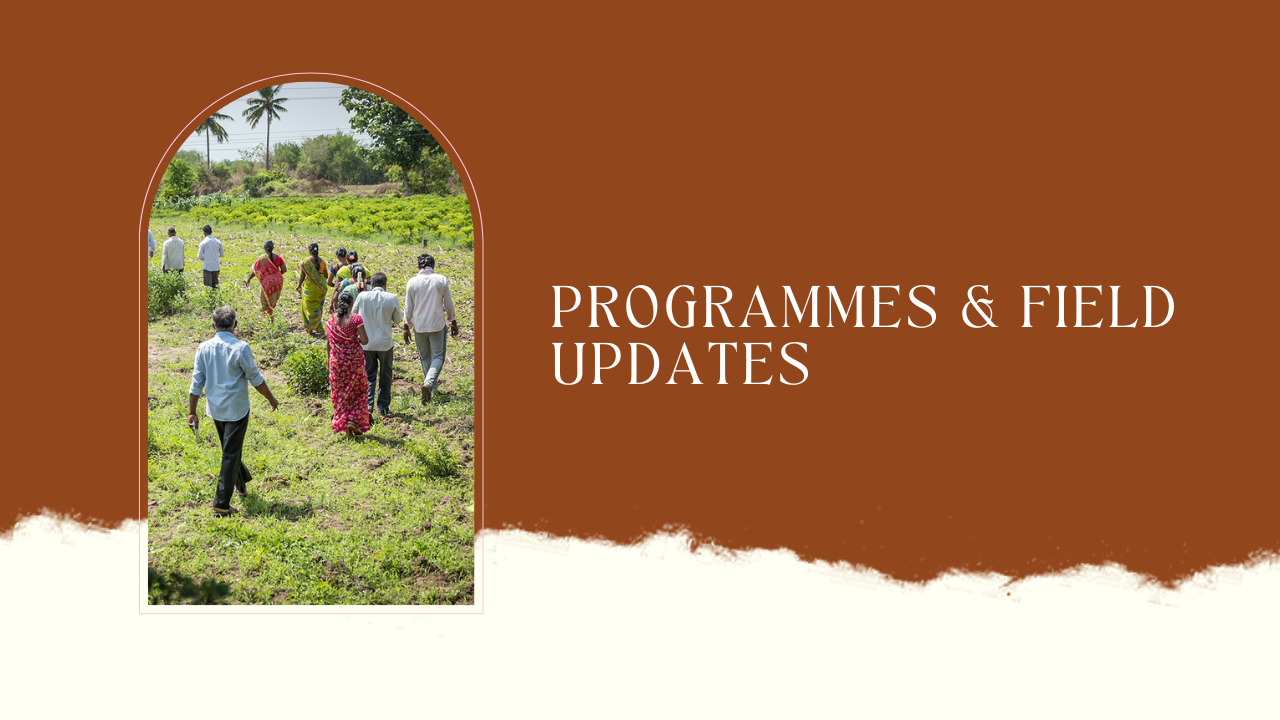
Inside Development Programs: How Field Implementation Works in India
Introduction
Development programmes often appear structured and well-defined on paper. Policies are drafted, plans are approved, and resources are allocated. However, the real transformation happens on the ground, where these plans are translated into action.
Field implementation is the most critical stage of any development programme. It is where strategies meet reality, challenges emerge, and impact is created.
Understanding how implementation works at the grassroots level provides valuable insight into the complexities and importance of development work.
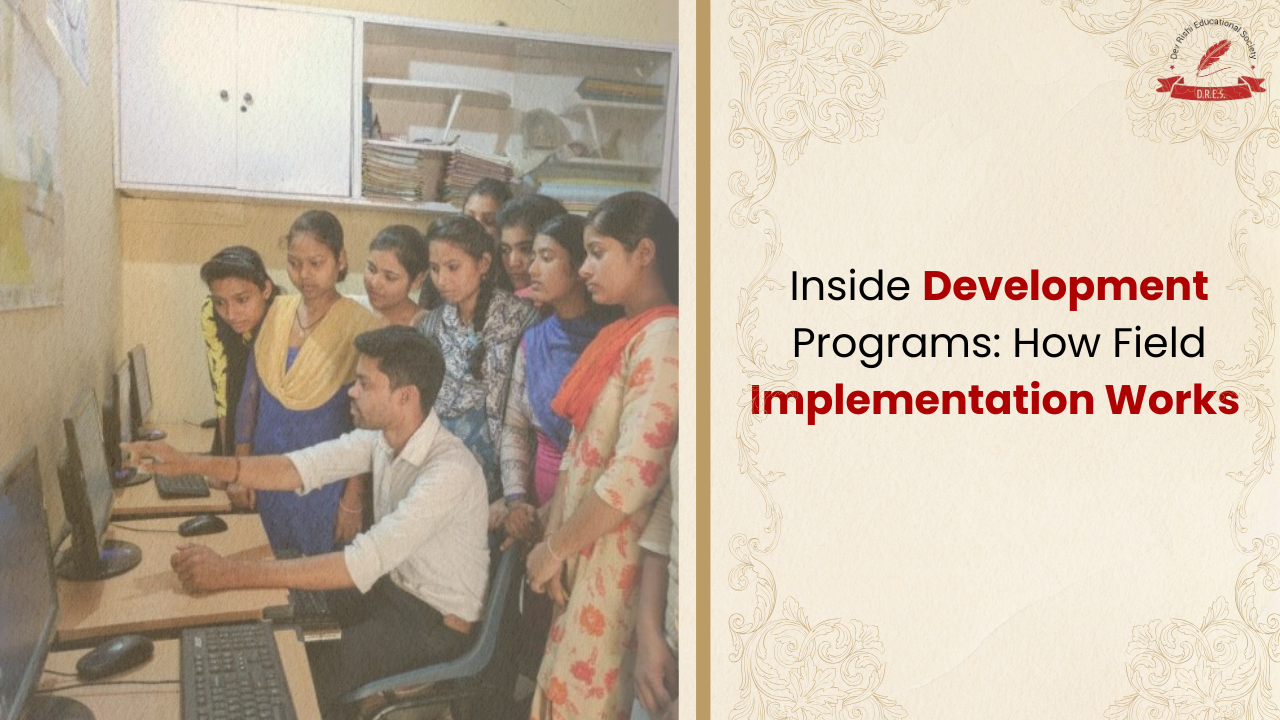
From Planning to Implementation
Every development programme begins with a structured plan, but real impact depends on how effectively it is implemented on the ground. Implementation requires adapting strategies to local realities and operational conditions.
The transition involves:
✷ Converting objectives into clear, actionable activities
✷ Aligning resources with real-time field requirements
✷ Coordinating closely with local stakeholders
This phase ultimately determines the success and effectiveness of the programme.
Key Stages of Field Implementation
1] Community Mobilization: Implementation begins with active community engagement. Awareness campaigns, meetings, and outreach activities are conducted to build understanding and involvement.
This helps in:
⬢ Building trust within communities
⬢ Encouraging active participation
⬢ Identifying the right beneficiaries
2] Baseline Assessment: Before initiating activities, field teams assess the existing situation to ensure relevance and accuracy in planning.
This includes:
⟡ Collecting data on key sectors such as livelihoods, health, and infrastructure
⟡ Identifying gaps and priority needs
⟡ Establishing benchmarks for impact measurement
Baseline insights ensure that interventions are targeted and effective.
3] Programme Delivery: This is the execution phase where planned activities are implemented on the ground.It may include:
⟢ Training sessions and capacity-building workshops
⟢ Infrastructure development and service delivery
⟢ Awareness campaigns and outreach initiatives
Strong coordination during this phase ensures timely and efficient delivery.
4] Monitoring and Supervision: Continuous monitoring ensures that implementation stays aligned with objectives.Field teams:
⟴ Track progress against planned activities
⟴ Identify challenges and bottlenecks
⟴ Make timely adjustments
Monitoring helps maintain quality, consistency, and efficiency.
5] Community Feedback and Adaptation: Feedback from beneficiaries is critical for refining programme delivery.It helps in:
⟲ Understanding real ground-level challenges
⟲ Identifying gaps in implementation
⟲ Improving strategies and delivery mechanisms
Adaptive approaches ensure better and more sustainable outcomes.
Role of Field Teams
Field teams play a central role in bridging plans and execution. Their direct engagement with communities ensures effective implementation.Their responsibilities include:
⧉ Conducting outreach and mobilization activities
⧉ Delivering training and essential services
⧉ Collecting field data and reporting insights
⧉ Coordinating with stakeholders at multiple levels
Their effectiveness directly influences programme success.
Challenges in Field Implementation
Field implementation involves several operational challenges:
⨳ Geographic and logistical constraints
⨳ Resistance to behavioral or systemic change
⨳ Limited awareness within communities
⨳ Resource limitations and coordination gaps
Addressing these challenges requires flexibility, planning, and problem-solving capabilities.
Importance of Local Context
Each community has unique socio-economic conditions, cultural practices, and priorities. Effective implementation depends on understanding these differences. Context-based approaches ensure:
⟟ Higher acceptance among communities
⟟ Increased participation levels
⟟ Long-term sustainability of outcomes
Role of Coordination and Partnerships
Successful implementation requires collaboration among multiple stakeholders, including:⌘ Government departments
⌘ Local institutions
⌘ Community groups
⌘ Development organizations
Strong partnerships enhance efficiency, resource utilization, and overall impact.
Measuring Success at the Ground Level
The effectiveness of implementation is measured through:
✺ Participation and engagement levels
✺ Achievement of planned targets
✺ Improvement in key outcomes
✺ Feedback from beneficiaries
These indicators provide clear insights into programme performance.
Impact on Communities
Effective field implementation translates planning into visible change:
✹ Improved livelihoods and income opportunities
✹ Better access to essential services
✹ Increased awareness and skill development
✹ Strengthened community systems
This is where development truly creates measurable impact.
The Way Forward
To strengthen field implementation, it is essential to:
⧗ Invest in capacity building of field teams
⧗ Leverage technology for monitoring and reporting
⧗ Strengthen community engagement mechanisms
⧗ Improve coordination across stakeholders
A structured and adaptive approach enhances both efficiency and impact.
Conclusion
Field implementation is where development strategies translate into real outcomes. It requires strong coordination, adaptability, and continuous engagement with communities.
Practical experience shows that well-structured implementation systems, combined with active community participation, lead to more effective and sustainable results.
Efforts carried out through organizations such as Dev Rishi Educational Society (DRES) demonstrate how strong field execution can convert plans into meaningful and lasting development impact.
How Community Participation
Improves Programme Outcomes in India
Introduction
Development programmes are designed to create positive change, but their success depends largely on the level of community involvement.
When communities actively participate, programmes become more relevant, effective, and sustainable.
Community participation transforms development from a top-down approach into a collaborative process. It ensures that initiatives are not just implemented for people, but with people.
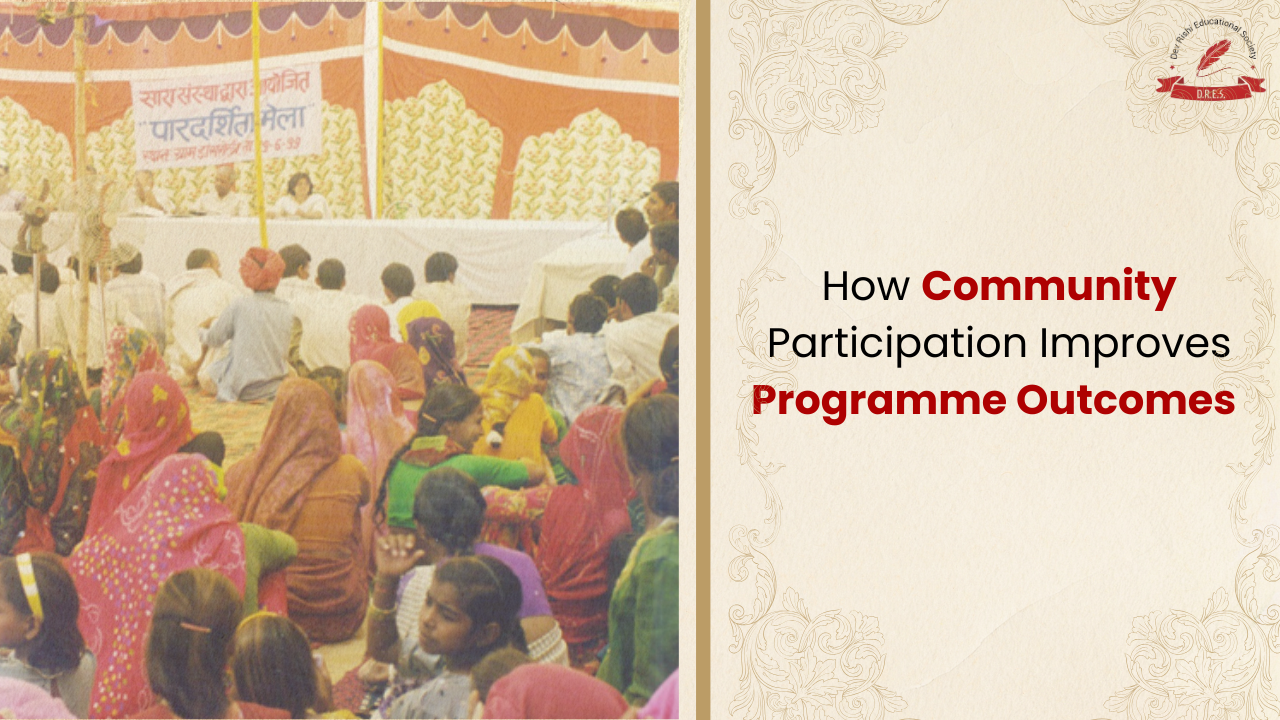
What is Community Participation?
Community participation refers to the active involvement of individuals and groups in planning, implementing, and monitoring development programmes.
It includes:
✻ Attending meetings and discussions
✻ Sharing local insights and needs
✻ Participating in programme activities
✻ Contributing to decision-making processes
Participation builds a strong sense of ownership and shared responsibility.
Why Community Participation Matters
Programmes designed without community input often fail to address real needs. Participation ensures that interventions are aligned with ground realities.
Key benefits include:
⬤ Better identification of local priorities
⬤ Increased acceptance of programmes
⬤ Improved efficiency in implementation
⬤ Long-term sustainability
When communities are actively involved, outcomes become more effective and sustainable.
How Participation Improves Programme Design
Community insights make programme design more practical and relevant.
It enables:
⟠ Identification of real challenges
⟠ Customization of solutions based on local needs
⟠ Clear prioritization of activities
This results in more targeted and impactful interventions.
Strengthening Implementation Through Participation
Active participation enhances the effectiveness of programme execution.
It helps in:
⟢ Increasing participation rates
⟢ Reducing resistance to change
⟢ Ensuring optimal use of resources
Communities become active partners rather than passive beneficiaries.
Enhancing Accountability and Transparency
Community involvement strengthens monitoring and transparency in implementation.
Participation leads to:
⟣ Greater oversight of activities
⟣ Improved accountability of implementing agencies
⟣ Timely identification of issues and gaps
Transparency builds trust and strengthens programme credibility.
Role in Behavioral Change
Many development initiatives require behavioral shifts. Community participation plays a key role in influencing such changes.Collective action helps to:
⟲ Encourage adoption of improved practices
⟲ Reinforce positive behaviors
⟲ Establish supportive social norms
Behavioral change becomes more sustainable when driven collectively.
Building Local Ownership
Ownership is one of the most critical outcomes of participation.
When communities feel responsible:
⟡ They actively contribute to programme success
⟡ They maintain systems and infrastructure
⟡ They ensure continuity beyond external support
Ownership ensures long-term sustainability and impact.
Challenges in Promoting Participation
Achieving meaningful community participation can be challenging.
Common barriers include:
⨁ Lack of awareness
⨁ Limited trust in institutions
⨁ Social and cultural constraints
⨁ Time and resource limitations
Overcoming these challenges requires consistent engagement and trust-building efforts.
Strategies to Enhance Community Participation
Effective participation requires structured and inclusive strategies.
Key approaches include:
⧗ Conducting regular awareness campaigns
⧗ Encouraging inclusive and diverse participation
⧗ Engaging local leaders and influencers
⧗ Applying participatory planning methods
⧗ Establishing continuous feedback systems
These strategies strengthen engagement and participation levels.
Impact on Development Outcomes
Strong community participation leads to visible and measurable improvements:
✺ Higher programme success rates
✺ Improved quality of outcomes
✺ Greater sustainability of initiatives
✺ Stronger and more resilient community systems
Participation transforms development into a shared and collective process.
The Way Forward
To strengthen community participation, it is important to:
⧉ Integrate participation into programme design
⧉ Build trust through continuous engagement
⧉ Promote inclusive and transparent processes
⧉ Strengthen local institutional capacity
A people-centered approach leads to more effective and sustainable outcomes.
Conclusion
Community participation is a fundamental driver of successful development programmes. It ensures that initiatives are relevant, accepted, and sustainable.Field experiences consistently show that programmes with strong community engagement deliver better outcomes and long-term impact.
Efforts facilitated through organizations such as Dev Rishi Educational Society (DRES) demonstrate how participatory approaches can strengthen implementation and create meaningful change at the grassroots level.
A Day in the Field: Understanding
Grassroots Development Work in India
Introduction
Behind every successful development programme lies a network of field teams working tirelessly at the grassroots level.
While reports and data highlight outcomes, the real story unfolds in villages, communities, and field locations where implementation happens daily.
Understanding a typical day in the field offers valuable insight into the realities, challenges, and impact of development work. It reveals how plans are translated into action and how small efforts contribute to meaningful change.
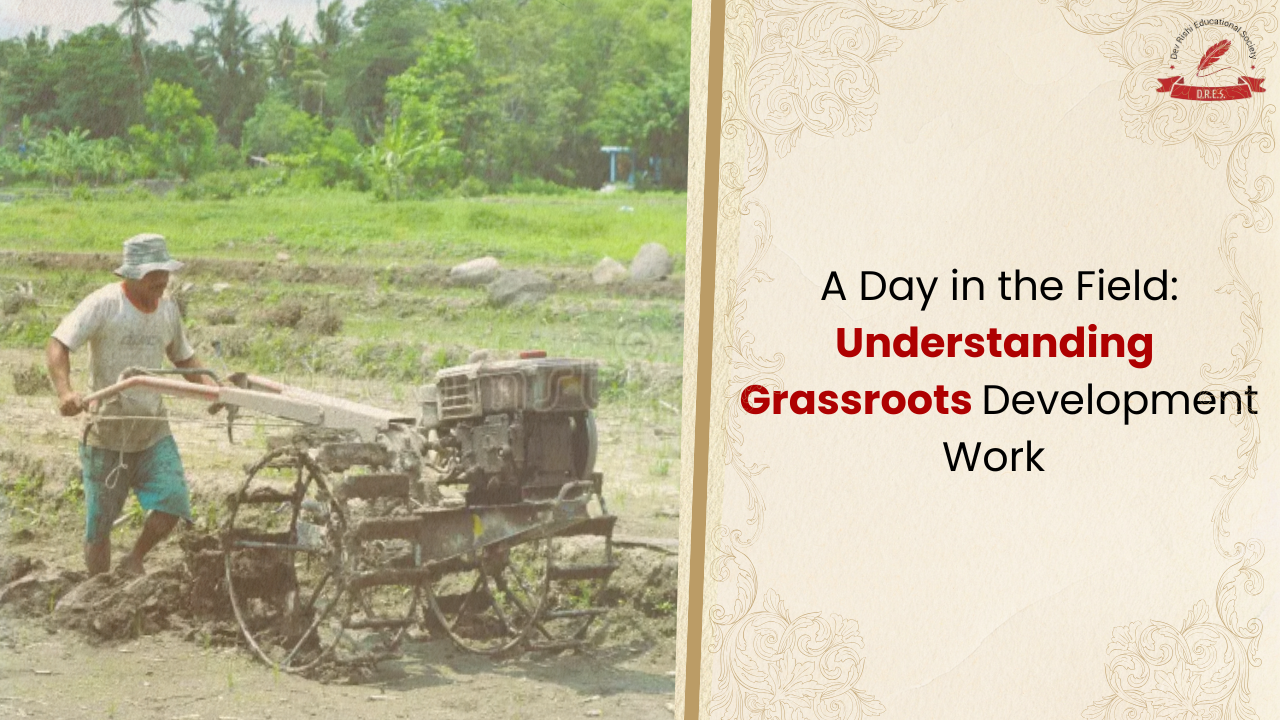
Early Morning: Preparing for the Day
A field worker’s day often begins early, with preparation setting the tone for effective execution. The day typically involves multiple activities and coordination with different stakeholders.
Typical preparations include:
✦ Reviewing the day’s plan and objectives
✦ Organizing training materials and resources
✦ Coordinating with team members
✦ Planning travel to field locations
Strong preparation ensures clarity and smooth execution throughout the day.
Travel to Field Locations
Reaching field locations is often a task in itself, especially in remote rural areas with limited connectivity.
Common realities include:
⬟ Long travel distances
⬟ Challenging terrain and road conditions
⬟ Limited transportation options
Despite these constraints, field teams ensure timely engagement with communities.
Community Engagement and Meetings
The day’s core activities often begin with direct interaction with communities.
This may include:
⟢ Conducting group meetings
⟢ Interacting with beneficiaries
⟢ Explaining programme objectives
⟢ Addressing questions and concerns
Consistent engagement helps build trust and strengthens relationships over time.
Conducting Training and Awareness Sessions
Training and awareness sessions form a critical part of fieldwork.
These sessions may focus on:
⟡ Skill development initiatives
⟡ Health and hygiene awareness
⟡ Governance and planning processes
⟡ Livelihood opportunities
Using practical demonstrations and local language communication enhances understanding and participation.
Data Collection and Documentation
Accurate documentation is essential for monitoring and evaluation.
Field teams are responsible for:
⟣ Conducting surveys and baseline assessments
⟣ Recording attendance and participation
⟣ Documenting activities and outcomes
Reliable data supports informed decision-making and programme improvement.
On-Ground Problem Solving
Fieldwork often involves addressing unexpected challenges in real time.
These may include:
⨳ Low participation levels
⨳ Resistance to new practices
⨳ Logistical constraints
⨳ Resource limitations
Effective problem-solving requires adaptability and practical thinking.
Coordination with Local Stakeholders
Successful implementation depends on strong local coordination.
This involves working closely with:
⌁ Community leaders
⌁ Panchayat representatives
⌁ Local institutions
Regular communication ensures alignment, support, and smoother execution.
Afternoon Follow-Ups and Monitoring
Follow-up activities ensure continuity and reinforce earlier interventions.
This includes:
⟲ Revisiting beneficiaries
⟲ Monitoring progress of activities
⟲ Addressing gaps and challenges
Regular follow-ups help sustain engagement and improve outcomes.
Evening Reporting and Review
At the end of the day, field teams consolidate their work through reporting and reflection.
Key tasks include:
⧉ Preparing daily reports
⧉ Sharing updates with supervisors
⧉ Identifying challenges and key learnings
Structured reporting ensures accountability and continuous improvement.
Challenges Faced During the Day
A field worker’s day is dynamic and often unpredictable.
Common challenges include:
⨯ Changing community dynamics
⨯ Weather-related disruptions
⨯ Limited resources
⨯ Time constraints
Despite these challenges, field teams remain focused on achieving their objectives.
Impact of Grassroots Work
Sustained field efforts lead to meaningful and visible changes over time:
✹ Improved awareness within communities
✹ Adoption of improved practices
✹ Enhanced livelihood opportunities
✹ Strengthened local systems
Grassroots engagement forms the foundation of long-term development.
Lessons from Field Experiences
Fieldwork offers practical insights that strengthen development approaches:
⟡ Importance of patience and persistence
⟡ Need for adaptability in dynamic environments
⟡ Value of building community trust
⟡ Significance of continuous engagement
These lessons help refine strategies and improve programme effectiveness.
The Way Forward
To strengthen field implementation and support teams, it is essential to:
⧗ Provide regular training and capacity building
⧗ Strengthen logistical and operational support
⧗ Leverage technology for monitoring and reporting
⧗ Encourage knowledge sharing and collaboration
Empowered field teams can significantly enhance programme impact.
Conclusion
A day in the field reflects the true essence of development work; it combines planning, engagement, problem-solving, and continuous learning.
Field experiences consistently demonstrate that strong implementation systems and dedicated teams are critical for achieving meaningful outcomes.
Work carried out through organizations such as Dev Rishi Educational Society (DRES) highlights how consistent field engagement and structured execution can translate development initiatives into sustainable impact at the grassroots level.
From Planning to Execution: Lifecycle of a Development Programme in India
Introduction
Development programmes are often seen through their outcomes, such as improved livelihoods, better infrastructure, or enhanced community awareness.
However, behind every successful initiative lies a structured process that moves from planning to execution and finally to impact.
Understanding the lifecycle of a development programme helps in appreciating how different stages contribute to achieving sustainable results. It also highlights the importance of coordination, monitoring, and continuous improvement.
What is the Lifecycle of a Development Programme?
The lifecycle of a development programme refers to the sequence of stages through which a project moves, from initial planning to final evaluation and impact assessment.
These stages ensure that programmes are:
✹ Well-designed
✹ Effectively implemented
✹ Continuously monitored
✹ Evaluated for impact
A structured lifecycle improves efficiency and overall outcomes.
Stage 1: Needs Assessment and Problem Identification
The process begins with a clear understanding of community needs.
This involves:
⬢ Conducting baseline surveys
⬢ Identifying key challenges
⬢ Engaging with stakeholders
⬢ Analyzing existing conditions
Accurate assessment ensures that programmes address real and relevant issues.
Stage 2: Programme Design and Planning
Based on identified needs, a detailed and structured plan is developed.
This includes:
⟡ Defining objectives and goals
⟡ Designing activities and interventions
⟡ Allocating resources effectively
⟡ Setting timelines and measurable targets
Strong planning creates a solid foundation for programme success.
Stage 3: Resource Mobilization
Resources are mobilized to support implementation.
These may include:
⟣ Financial resources
⟣ Skilled human resources
⟣ Infrastructure and materials
Efficient allocation ensures smooth and uninterrupted execution.
Stage 4: Community Mobilization
Communities are engaged before implementation begins to ensure awareness and participation.
Activities include:
⟢ Awareness campaigns
⟢ Community meetings
⟢ Stakeholder consultations
Mobilization builds trust and strengthens participation.
Stage 5: Programme Implementation
This is the execution phase where planned activities are carried out on the ground.
It may involve:
⌁ Training and capacity building
⌁ Infrastructure development
⌁ Service delivery
⌁ Awareness initiatives
Effective coordination during this stage is essential for achieving desired outcomes.
Stage 6: Monitoring and Supervision
Continuous monitoring ensures that the programme remains on track.
This involves:
⟴ Tracking activities and outputs
⟴ Identifying challenges and gaps
⟴ Making necessary adjustments
Monitoring improves efficiency, quality, and accountability.
Stage 7: Evaluation and Impact Assessment
After implementation, programmes are evaluated to measure their effectiveness.
This includes:
⟲ Assessing outcomes and long-term impact
⟲ Comparing baseline and endline data
⟲ Identifying lessons learned
Evaluation provides insights for future improvements.
Stage 8: Feedback and Learning
Feedback from beneficiaries and stakeholders helps refine programme approaches.
This helps in:
⟟ Improving implementation strategies
⟟ Addressing gaps and challenges
⟟ Strengthening programme design
Continuous learning supports long-term effectiveness.
Stage 9: Sustainability and Scaling
The final stage focuses on ensuring long-term impact and expanding successful models.
This includes:
⧉ Strengthening local ownership
⧉ Integrating programmes with existing systems
⧉ Scaling successful interventions
Sustainability ensures that benefits continue beyond the programme duration.
Importance of a Structured Lifecycle
Following a structured lifecycle ensures:✺ Better planning and execution
✺ Efficient use of resources
✺ Improved accountability
✺ Higher impact and sustainability
It creates a systematic and result-oriented approach to development.
Challenges in Managing the Lifecycle
Managing multiple stages of a programme lifecycle can be complex.
Common challenges include:
⨳ Coordination across different stages
⨳ Resource constraints
⨳ Variability in field conditions
⨳ Data and monitoring limitations
Strong systems and processes are required to address these challenges effectively.
Role of Coordination and Partnerships
Effective lifecycle management requires collaboration between multiple stakeholders, including:
⌘ Government bodies
⌘ Development organizations
⌘ Local institutions
⌘ Community groups
Strong partnerships enhance efficiency, resource sharing, and impact.
Impact on Development Outcomes
When the lifecycle is managed effectively, the results are significant:
✷ Better programme performance
✷ Improved community outcomes
✷ Increased sustainability
✷ Stronger institutional systems
A structured approach leads to meaningful and measurable change.
The Way Forward
To strengthen programme lifecycle management, it is important to:
⧗ Invest in planning and capacity building
⧗ Strengthen monitoring and evaluation systems
⧗ Promote data-driven decision-making
⧗ Encourage active community participation
A comprehensive approach enhances overall effectiveness and impact.
Conclusion
The lifecycle of a development programme provides a structured pathway from planning to impact.
Each stage plays a critical role in ensuring that initiatives are effective, efficient, and sustainable.Field-level experiences consistently show that programmes following a well-defined lifecycle achieve stronger outcomes and long-term impact.
Efforts implemented with the involvement of organizations such as Dev Rishi Educational Society (DRES) demonstrate how structured planning, execution, and evaluation can contribute to meaningful and sustainable development.